Published: 20 May 2026 | Updated: 26 Sept 2026


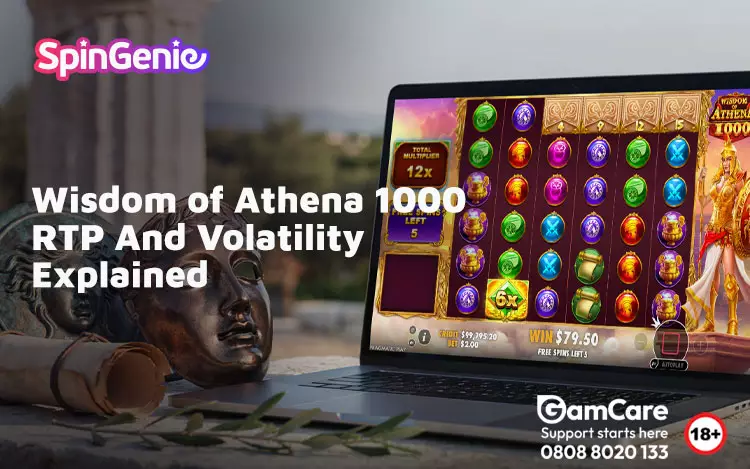

Quick Answer: Wisdom of Athena 1000 has a theoretical RTP of 96% and high volatility. RTP describes the game's theoretical long-term return over millions of spins, while volatility explains its payout pattern and level of risk. Together, these metrics provide useful insight into the game's mathematical design without predicting individual outcomes.
Key Facts
- RTP:96% (theoretical long-term return)
- Volatility: High
- RTP represents the game's theoretical long-term return percentage.
- High volatility describes a game with greater variation in how theoretical returns are distributed. It does not predict how frequently an individual player will receive a winning outcome.
- RTP and volatility are separate metrics that describe different aspects of the game's mathematical design.
- All slot outcomes are determined by Random Number Generator (RNG) technology and chance.
If you're looking to play Wisdom of Athena slot, understanding RTP and volatility can help you learn more about the game's overall structure. While many players focus on themes, bonus features and symbols, RTP and volatility provide valuable insight into how the slot is designed behind the scenes. Together, these concepts help explain the balance between risk, payouts and gameplay variation.
What Is RTP?
Wisdom of Athena has a theoretical Return to Player (RTP) of 96%.
RTP represents the theoretical percentage of total wagers that a slot is expected to return to players over an extended period of play. According to industry standards, RTP is calculated across millions of simulated spins and reflects long-term mathematical performance rather than short-term results.
How RTP Works
To understand RTP more clearly, consider a simplified example.
If a slot has a theoretical RTP of 96%, it is expected to return £96 for every £100 wagered over a very large sample of gameplay.
However, this does not mean:
- A player will receive $96 back during a session.
- Results will follow a predictable pattern.
- Returns are guaranteed.
Individual experiences can vary significantly because every spin is independent.
Why RTP Matters
RTP helps players compare different slot games and understand how they are mathematically structured. Some reasons players look at RTP include:
- Comparing games
- Understanding theoretical returns
- Researching slot mechanics
- Learning how games differ
RTP is best viewed as a long-term informational metric rather than a predictive tool.
Common RTP Misconceptions
Many players misunderstand what RTP actually means.
RTP does not:
- Predict future wins
- Influence spin outcomes
- Guarantee returns
- Reveal when payouts will occur
Each spin remains completely random regardless of RTP.
Understanding Wisdom of Athena RTP
With a theoretical RTP of 96%, Wisdom of Athena provides insight into the game's long-term mathematical return. However, RTP is only one aspect of the game's overall design and should always be considered alongside high volatility, bonus features, and payout distribution.
Two slots with similar RTP values can feel very different during gameplay because of differences in volatility and feature design. This is why experienced players often evaluate multiple game characteristics rather than focusing on a single statistic.
Volatility Explained
In addition to its 96% RTP, Wisdom of Athena features high volatility.
While RTP focuses on theoretical returns, volatility focuses on risk and payout behaviour. It describes how often wins may occur and how large those wins might be relative to one another.
What Does High Volatility Measure?
High volatility helps explain the game's payout pattern. A high-volatility classification indicates greater variation in the game’s theoretical payout distribution. Individual outcomes remain random
Volatility does not change the game's RTP. Instead, it affects how payouts are distributed over time.
Common Volatility Categories
|
Volatility Level |
General Characteristics |
|
Low |
Smaller outcomes may appear more frequently |
|
Medium |
Balance between frequency and payout size |
|
High |
Larger outcomes may occur less often, with greater payout variation |
These descriptions are general guidelines rather than guarantees.
Why Volatility Matters
High volatility can significantly influence how a game feels during a session. For Wisdom of Athena, it may affect:
- Session pacing
- Payout distribution
- Feature frequency
- Overall gameplay rhythm
Understanding volatility helps players build a clearer picture of how a slot operates beyond its RTP percentage.
RTP vs Volatility
Although RTP and volatility are often discussed together, they measure different aspects of a slot's mathematical design.
|
RTP |
Volatility |
|
96% theoretical long-term return |
High volatility |
|
Measures theoretical long-term returns |
Measures payout distribution and risk profile |
|
Expressed as a percentage |
Expressed as a volatility category |
|
Calculated across millions of spins |
Describes gameplay behaviour |
|
Does not predict outcomes |
Does not predict outcomes |
Both metrics are useful, but they answer different questions about how a slot is designed.
Understanding Win Rate
Another term players frequently encounter is win rate.
What Is Win Rate?
Win rate generally refers to how often a game may produce a winning outcome relative to total spins.
It is important to understand that win rate differs from:
- RTP
- Volatility
- Total payout potential
A game can have a relatively frequent win rate while still delivering smaller average outcomes, depending on its design.
Win Rate And Slot Design
Several factors contribute to win rate, including:
- Symbol distribution
- Reel configuration
- Feature mechanics
- Payout structure
These elements work together to shape the overall gameplay experience.
Why Win Rate Can Be Misleading
Win rate alone does not provide a complete picture of a slot.
For example:
- Frequent smaller outcomes may occur.
- Larger outcomes may occur less often.
- Bonus features may contribute differently to overall returns.
This is why RTP and volatility are generally viewed alongside win rate rather than separately.
Bonus Features And RTP
Bonus features play an important role in many modern slots, including Wisdom of Athena 1000.
Features such as:
- Free spins
- Multipliers
- Bonus rounds
- Special symbols
They all contribute to the overall mathematical structure of the game.
If you'd like to learn more about how these mechanics work, our dedicated bonus guide explores the game's feature system in greater detail.
Understanding bonus mechanics can help provide additional context when evaluating RTP and volatility.
Comparing Similar Games
Players researching RTP and volatility often compare multiple slots before choosing which games to explore.
Comparisons may focus on:
- RTP figures
- Volatility levels
- Bonus features
- Gameplay style
- Thematic presentation
If you're interested in exploring other mythology-themed titles, our guide to alternatives highlights several games with comparable themes and gameplay elements.
RTP, Volatility And Responsible Gaming
RTP, volatility and win rate are designed to help explain how games operate mathematically.
However, none of these statistics can predict individual outcomes. Results are determined by a Random Number Generator (RNG). Outcomes are based on chance only.
Players should always view slot games as a form of entertainment and play responsibly within their personal limits.
Conclusion
Understanding RTP, volatility, and win rate can help provide a clearer picture of how Wisdom of Athena 1000 is structured. With a theoretical RTP of 96% and high volatility, the game is designed to offer long-term mathematical returns alongside a payout pattern that may feature less frequent but more variable wins. While RTP explains theoretical returns, volatility describes payout behaviour, and win rate provides additional context about gameplay frequency.
Together, these metrics help players understand different aspects of the game's design without suggesting or predicting future outcomes. Whether you're exploring Wisdom of Athena 1000 for the first time or comparing it with other mythology-themed slots, understanding these concepts can help you make more informed decisions when choosing games to explore at Spin Genie.
| Disclaimer: The house will always have the edge. Players should never try to recover losses by gambling more. The outcome of the games is always entirely based on luck. |
FAQs
What does RTP mean in Wisdom of Athena 1000?
RTP stands for Return to Player and represents the theoretical percentage of wagers a game is expected to return over the long term.
Is RTP the same as volatility?
No. RTP measures theoretical returns, while volatility describes how payouts may be distributed throughout gameplay.
Can RTP predict future wins?
No. RTP is a mathematical model calculated over millions of spins and cannot predict individual outcomes.
Why is volatility important?
Volatility helps explain how often payouts may occur and how large those payouts might be relative to one another.